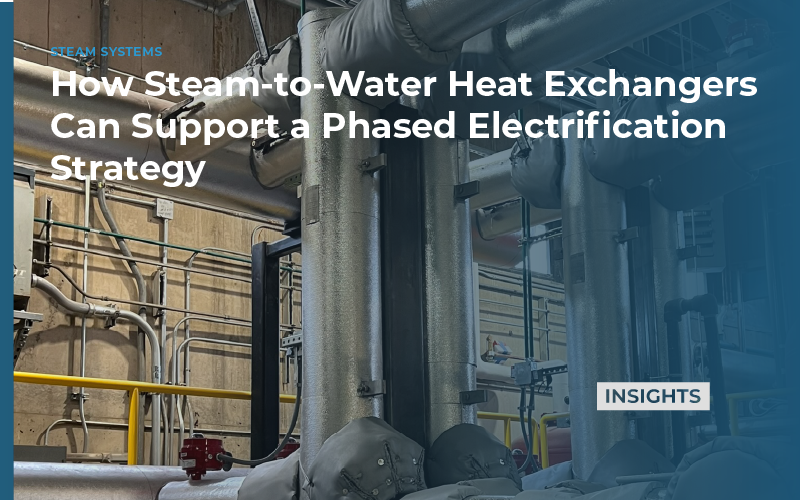
A facility can know it wants to move toward electrification without being ready to replace its steam plant today. That gap between intent and readiness is where the real question lives.
The DOE delay creates time, not certainty
On September 2, 2026, DOE delayed its onsite fossil-fuel requirements for certain new federal buildings and major renovations until March 1, 2027. That's a pause, not a repeal. Electrification and decarbonization are still part of the long-term plan for a lot of facilities, federal and otherwise, and the policy timeline moving doesn't change that.
What it does change is the pressure. A facility can know it wants to move toward electrification without being ready to replace its steam plant this year, or even this decade.
How can a facility improve the system it has now without investing in infrastructure that works against the plan it's building toward?
Steam and electrification don't have to be an either-or decision
Producing heat and distributing heat are two different problems, and they don't have to be solved on the same timeline.
A facility can keep producing steam centrally while it starts converting sections of a campus, or a building, to heating hot water. Splitting the two decisions apart opens up a phased path:
The steam plant becomes the temporary heat source while the facility builds the hot-water system it expects to run on long term.
A campus already running this playbook
Cornell University is gradually converting its Ithaca campus from steam distribution to hot water as part of its 2035 carbon-neutrality plan, and the sequencing matches the phased approach above.
The central plant keeps producing steam. Thermo-Pack® converts that steam into heating hot water, which gets distributed to other areas of campus in place of steam. At each building, plate-and-frame heat exchangers transfer that heat into the building's own closed-loop hot water system, in the 120–180°F range used for space heating, a loop that can serve AHU heating coils as readily as any other heating equipment.

As the conversion moves forward, aging steam and condensate infrastructure comes out in phases, and the new hot-water piping is left in place to connect to geothermal, heat pumps, storage, or whatever heat source the campus lands on next.
Cornell describes the hot-water conversion as “technology agnostic,” since the piping isn't locked to one future heat source. Cornell has also reported that moving from steam to hot-water distribution is expected to reduce energy losses, maintenance costs, and worker risk across the campus. That's a campus-wide distribution result, not a number specific to any one piece of equipment, and it's worth reading straight from Cornell's own conversion overview rather than taking secondhand.
Where Thermo-Pack® fits
Thermo-Pack® is the bridge between the steam a facility already produces and the hot-water infrastructure it's building toward. It still runs on steam, but it's engineered to get more out of that steam than a traditional shell-and-tube system, by:
How much of an advantage that adds up to depends on the application: steam pressure, water temperatures, flow rate, design load, partial-load behavior, existing equipment, and condensate-return requirements all move the number. That's why Cooney's engineering team calculates Thermo-Pack® performance against a traditional shell-and-tube selection for the specific project instead of quoting a figure that's supposed to apply everywhere. Efficiency and savings claims should come from that calculation, not a general assumption carried over from another job.
Improve today's system without losing sight of tomorrow
The regulatory delay may buy federal facilities more time, but it doesn't answer the long-term question on its own. A good transitional project holds up under more than one future:
That makes Thermo-Pack® more than a replacement for an aging heat exchanger. In the right application, it's a way to connect the infrastructure a facility already owns to the system it's planning to run on next.
Questions worth asking before you specify
- How long is the existing steam plant expected to stay in service?
- Can the facility begin converting individual buildings or districts to hot water now?
- What heating-water temperatures will current and future equipment need?
- Could a steam-to-water system serve as the temporary bridge?
- How does calculated Thermo-Pack® performance compare with a traditional shell-and-tube selection for this application?
You don't have to finish the transition before you start it
Cooney Technologies can help evaluate the steam-to-water interface and calculate how Thermo-Pack® would perform under your current and future design conditions.
Discuss Your Steam-to-Hot-Water Project