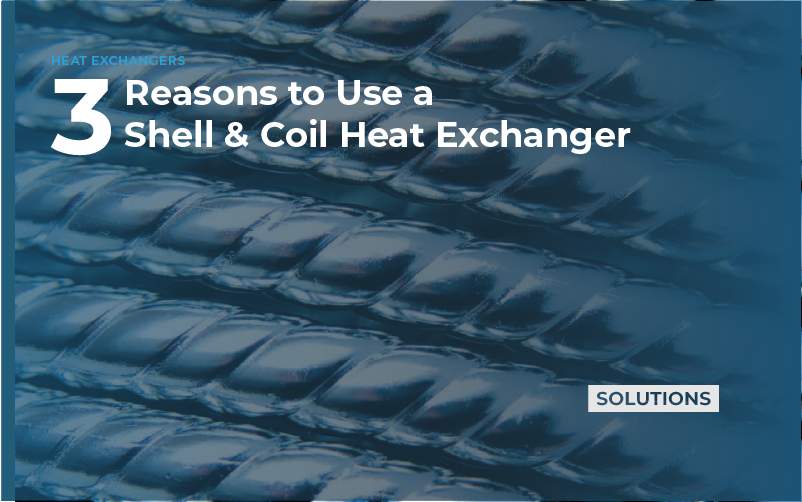
A shell and coil heat exchanger is a steam to water heat exchanger that uses helically wound, corrugated stainless steel tubes instead of the straight tube bundles found in traditional shell and tube units. The coiled design transfers more heat in less space, which is why facilities replacing aging shell and tube systems are increasingly specifying shell and coil instead.
If your mechanical room still runs on a shell and tube unit, here is what the difference actually means for your energy bill, your floor space, and your maintenance schedule.
HOW IT WORKS
What Is a Shell & Coil Heat Exchanger?
Inside a shell and coil unit, steam flows through dimpled, helically corrugated 316L stainless steel tubes while water flows through the surrounding shell. The cross-counterflow design captures the latent heat of the steam and the sensible heat of the condensate, a process called condensate subcooling. Steam gives off its heat, condenses, then keeps cooling to recover energy a shell and tube unit sends down the drain as flash steam.
The result: When the unit is sized and selected to subcool, the result is more BTUs captured per pound of steam with 0% flash steam.
THE CASE FOR SHELL & COIL
Why Choose a Shell & Coil Over a Shell & Tube?
There are three reasons facilities make the switch: energy savings, footprint, and maintenance.
1. Energy Savings
A shell and coil system sized and selected for the load, like the Thermo-Pack®, saves 10-15% on steam consumption vs. a traditional shell and tube.
The subcooling that drives the savings is engineered into the selection.
2. Compact Footprint
Shell and tube units mount horizontally and claim serious floor space at larger loads. Shell and coil units mount vertically, making them a strong fit for retrofits and tight mechanical rooms, with lower installation cost.
3. Lower Maintenance
Fully welded 316L stainless steel. No tube sheet, no rolled joints to loosen, no tube bundle to pull or replace. Fewer welded joints mean fewer leak points, and uniform heat transfer reduces erosion and scaling.
BY THE NUMBERS
The Same Load, Two Very Different Results
Run the numbers on an identical domestic hot water load and the gap shows up fast. These results come from a Thermo-Pack® skid that Cooney Technologies sized and selected for the application. The subcooling is engineered into the selection. It does not come standard on an off the shelf unit.
| Sample DHW Comparison | Thermo-Pack® (Sized & Selected) | Shell & Tube |
|---|---|---|
| Avg Condensate Temp | 110°F | 249°F |
| Steam Consumption | 1,382 lb/hr | 1,587 lb/hr |
| Sub-Cooling Energy Recovery | 194,159 BTU/hr | 0 BTU/hr |
| Flash Steam | 0% | Vented losses |
Want to run your own numbers? Use the steam energy comparison calculator.
THE PACKAGED OPTION
Thermo-Pack®: Shell & Coil, Engineered as a Complete System
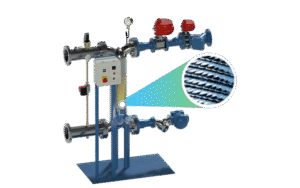 Cooney Technologies engineers the Thermo-Pack®, a packaged, skid-mounted shell and coil steam to water heating system for domestic hot water and heating hot water applications. Every skid arrives complete: 316L stainless steel shell and coil heat exchanger, NEMA 4 control panel with optional BACnet, Modbus, or LON integration, steam-side V-ball control valve with 300:1 turndown, safety shutoff, strainer, recirculating pump, and PID temperature control accurate to ±4°F.
The heat exchanger carries a 5-year warranty and is backed by installations like Cornell University’s North Campus Residential Expansion, where Thermo-Pack® units handle DHW and HHW for 2,000 beds and a dining hall.
Ready to talk through your steam system? Request a quote or call (610) 783-1136.
FREQUENTLY ASKED QUESTIONS
Shell & Coil Heat Exchanger FAQs
How much energy does a shell & coil heat exchanger save?
What is a shell & coil heat exchanger made of?
Quality shell and coil units use fully welded 316L stainless steel with helically corrugated, dimpled tubes. Stainless construction resists the corrosion, thermal shock, and fouling that shorten the life of carbon steel shell and tube units.
Do shell & coil heat exchangers take up less space than shell & tube?
Yes. Shell and coil units mount vertically, so they occupy a fraction of the floor space of a horizontally mounted shell and tube unit with the same capacity. That makes them well suited to retrofits and tight mechanical rooms.
What maintenance does a shell & coil heat exchanger need?
Routine water-side cleaning through threaded access ports. There is no tube bundle to pull or replace, and the fully welded stainless construction has fewer joints that can leak over time.