The first hard freeze of the season never announces itself. A damper sticks open. A preheat valve hesitates. A freezestat trips a few minutes too late. By the time anyone walks into the mechanical room, the coil has split, water is on the floor, and a routine morning has turned into an emergency.
That scene, repeated every winter, is where Freeze Block® began.
It didn't start with a product. It started with a problem.
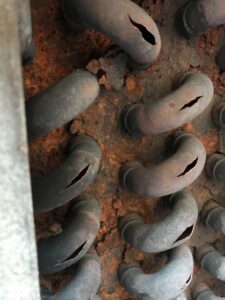
Freeze Block® came out of the field, not a lab. Our founder, Bob Cooney, spent years in mechanical rooms across the Philadelphia region, replacing frozen and ruptured coils alongside the people responsible for keeping those buildings running. Every cold snap brought the same calls, the same cleanup, and the same question from facility teams: why does this keep happening?
When a customer asked for something better, the answer wasn't another workaround. It was a return to first principles: using a background in pipe freezing equipment and valve engineering to study the physics of coil freezing from the ground up.
The question that changed everything: what actually breaks the coil?
Most freeze protection is built around one goal: keep the coil from freezing. Freezestats, pumps, glycol, dampers and draining all take a shot at it. Each one works until it doesn't, and when it fails, the coil is on its own.
The physics pointed somewhere different. You can't guarantee a coil will never freeze. But freezing isn't what destroys it.
Water expands as it turns to ice. Inside a coil tube, ice forms in plugs, and the water trapped between those plugs has nowhere to go. Pressure climbs until the weakest point gives, and the tube splits. The coil ruptured, but it was the victim.
So the problem worth solving wasn't coil freeze. It was coil rupture.
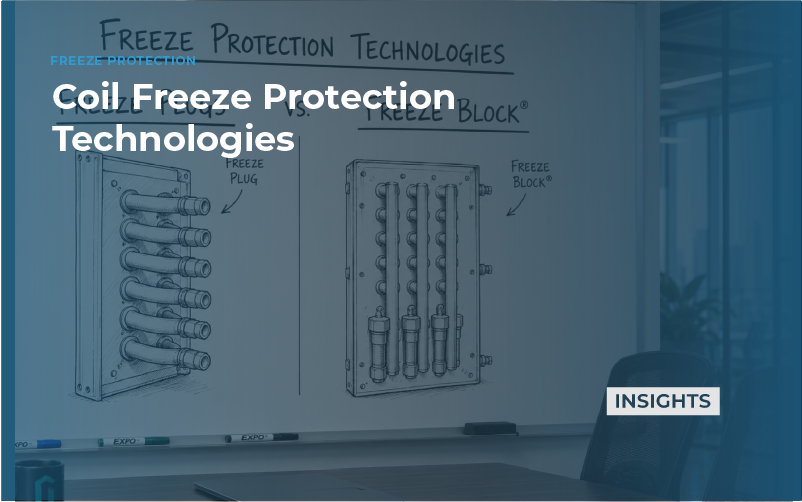
That insight became Freeze Block®: HVAC coils with freeze protection built in. When temperatures drop, the Freeze Block® valve relieves pressure in the coil so it can freeze without rupturing. The valve re-seats mechanically on its own and does not need to be replaced. No controls to fail, no power to lose, and no one has to respond at 3 a.m.
Why -74°F

A design that works on paper isn't good enough for a mechanical room above an operating suite or a research lab. The goal wasn't just to prove Freeze Block® worked on a typical January night. It was to find out where it stopped working.
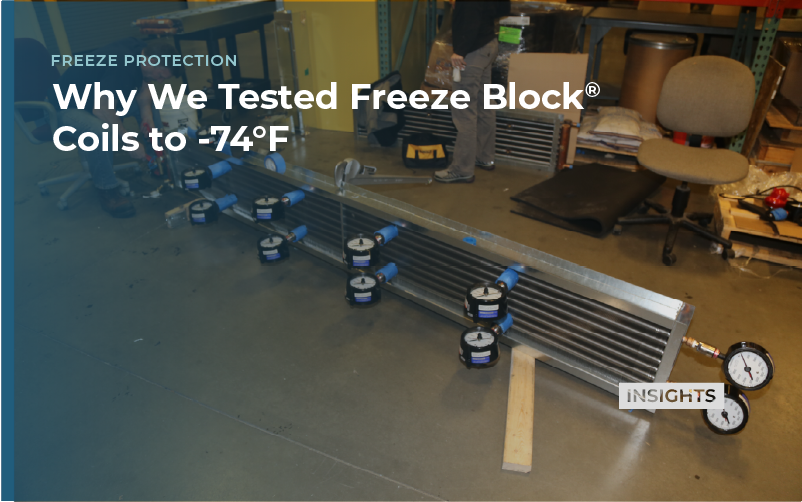
So it went into a climate room, and the temperature kept dropping. Freeze Block® was climate-room tested to -74°F, far colder than nearly any air handler will ever see, and wind tunnel tested alongside leading engineers in the coil industry.
That margin is the point. When a damper sticks open during a deep cold snap, nobody wants to find out the hard way where the protection ends.
What happens when everything else fails
The real test isn't the climate room. It's the night the rest of the system goes down.
At the University of Pennsylvania, that night came. Roy Stein, Utilities Operations Manager, put it this way:
"We were very happy that when our system failed, our coils did not rupture. Instead, the relief valves had discharged and when we thawed the coils they went back into operation with no leaks. This event made believers out of us."
No flooded air handler. No emergency replacement. The coils thawed and went back to work.
One problem, then a way of working
Since its invention in 2014, Freeze Block® has grown to thousands of installations across North America, supported by a nationwide network of manufacturers' reps. The engineering didn't stop there.
- Smart Coil™: Princeton University helped develop the first Smart Coil™, an add-on that ties a Freeze Block® valve deployment into the building automation system. It works like a freezestat, but only triggers on an actual freeze event, so there are no nuisance alarms.
- Thermo-Pack®: Work with Cornell University led to the Thermo-Pack® heat exchanger.
The approach has been the same every time: start with a real failure, then work the physics until it's solved.
What that means for your building this winter
That instinct, to solve the problem instead of accepting it, is still what every person at Cooney Technologies runs on. Freeze Block® coils carry a 30-month freeze protection warranty, and when you call, you'll get a person who picks up, knows the product, and owns the problem until it's solved.
If freeze risk is on your list this season, here's where to start:
- Near our King of Prussia, PA headquarters: our local team will come out, measure, and engineer the replacement.
- Anywhere else in North America: connect with one of our manufacturers' reps.
- Specifying a new project: request a Freeze Block® spec review.
Explore Freeze Block® and our other technologies
Cooney Technologies. Engineered for What Happens Next.