
Why Do HVAC Coils Freeze?
HVAC coils freeze when the water inside the tubes drops to 32°F or below, turns to ice, and expands until the tube splits. The freeze itself isn’t really the problem. The split tube is cheap. What it lets loose is not: a flooded mechanical room, days of downtime, a space nobody can use until it’s dried out and repaired, and an emergency labor bill on top of all of it.
So this page is about the why. Why coils freeze in systems that were designed right, what actually goes wrong when they do, and which of the usual prevention methods hold up once you’re out of the spec sheet and into a real winter.
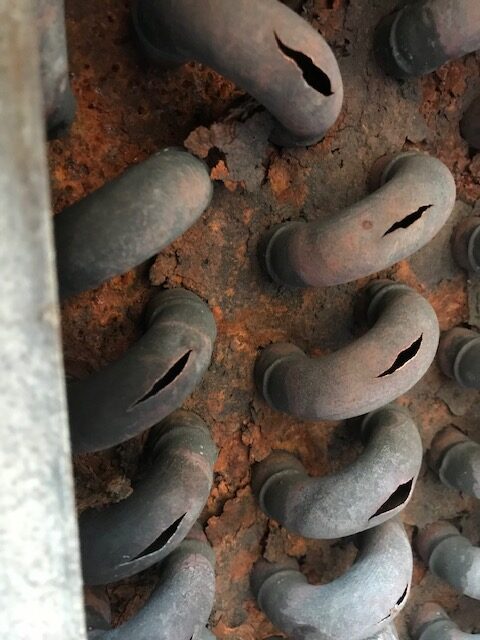
How a Coil Freeze Happens
The mechanics are simple. Water freezes, water expands, and a copper tube is no match for it. Here’s the chain, and it’s the same whether the coil runs fluid or steam:
-
1
Water or condensate inside the coil reaches 32°F or below.
-
2
The water turns to ice and expands.
-
3
Expansion builds immense pressure inside the tubing.
-
4
The tube splits, often in several places along one coil.
-
5
When the ice thaws, fluid leaks everywhere.
The Part That Catches People Off GuardThe airstream doesn’t have to be uniformly at freezing for the coil to fail. A single band of air sitting below 32°F is enough to freeze and split the tubes in that zone — while the rest of the coil runs in normal mixed air and the controls read fine.
How Fluid and Steam Coils Freeze
Fluid coils and steam coils don’t freeze the same way, and the difference matters. It changes what you watch for and how you protect them.
How Fluid Coils Freeze
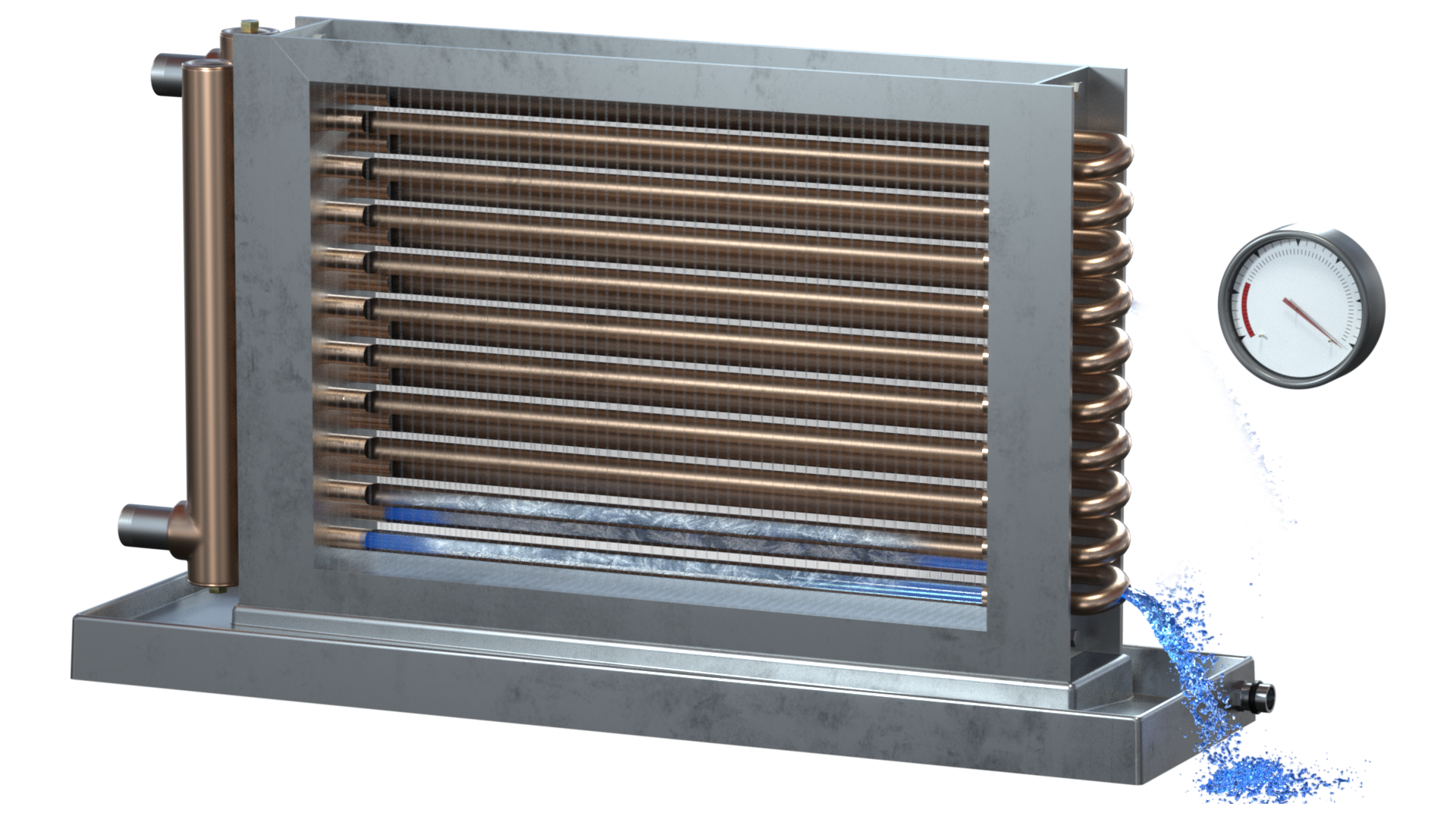
Fluid coils (hot water, chilled water, glycol) move heat between the liquid in the tubes and the air going across them. Drop that liquid to 32°F and it freezes, expands, and the tube can go in minutes. And it’s never just one tube, in our experience. By the time you find the rupture you’re usually looking at several splits, water in the floors and walls and equipment, and a mold remediation job waiting behind it.
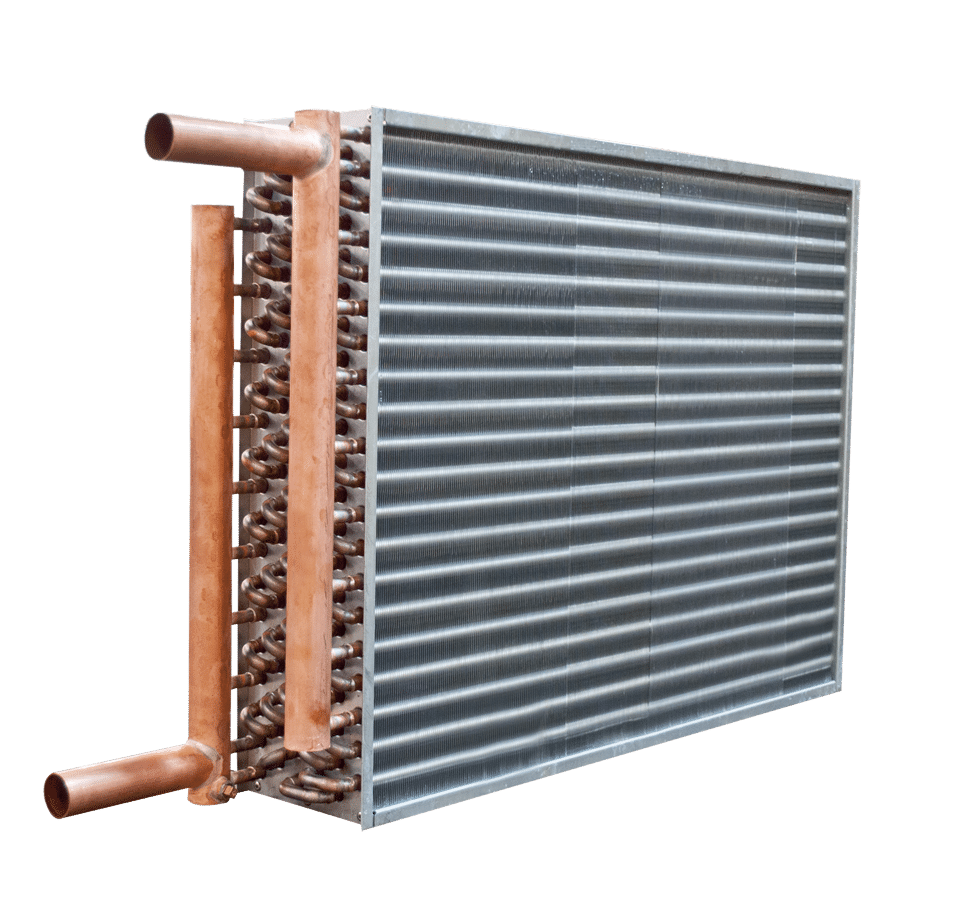
A fluid water coil — copper tubes, aluminum fins.
Stratification — The Hidden Cause
That uneven band has a name: stratification. When outdoor air and return air meet ahead of the coil, they don’t fully mix. They have different densities and temperatures, and that difference doesn’t resolve itself in the short run before the air hits the face. The cold, denser air settles into a layer, usually low, and holds there. So the coil sees a temperature gradient across its face, not a single average. Pull a sensor reading from the mixed airstream and it can look perfectly safe, while the bottom of the coil is sitting in sub-freezing air the whole time. That’s what makes stratification dangerous: it’s a localized failure the system-level instrumentation isn’t positioned to catch.
How Steam Coils Freeze
A steam coil warms air by running steam through tubes wrapped in aluminum, copper, or stainless fins. Two kinds worth knowing: standard steam coils, usually for reheat, and steam-distributing coils, which you need once the incoming air drops below 40°F.
Steam coils freeze on the leftover: the condensate sitting in the tubes after the steam gives up its heat. When that water freezes, you’ve got a freeze-up. Almost always it traces back to one of two things:
A steam-distributing coil for sub-40°F incoming air.
- ● Steam trap problems
The trap clears condensate from the lowest point of the coil. If it’s installed wrong, condensate stays in the coil and freezes when it meets cold outside air.
- ● Vacuum breaker problems
The vacuum breaker helps drain condensate, prevents water hammer, and evens out temperatures. It must sit on the control valve and always above the steam trap.
Why Coils Freeze Even When the System Was Designed Right
Here’s what surprises people: most frozen coils weren’t badly designed. The design was fine. What gets them is everything that happens after the design, the stuff a drawing can’t account for. Controls fail. The power goes out. A damper sticks. Somebody changes a setpoint in October and nobody touches it again. That’s where freeze events actually come from.
Power or Central Plant Failure
When a big outage hits, the pumps and air handlers stop. Now the inside of that AHU cabinet is just matching whatever it is outside, and on the wrong night, the coil is one of the first things in the whole building to go. You don’t even need a full blackout, either. Plenty can go wrong inside a steam or hot water plant that starves a coil of heat while the lights stay on:
- PRV failure: the gatekeeper for steam or hot water flow stops controlling it.
- Control valve failure: flow to the coil is interrupted.
- Piping blockage: a “traffic jam” keeps heat from reaching the coil.
- Central boiler failure: the heat source goes down and everything downstream is exposed.
Mechanical and Controls Failure
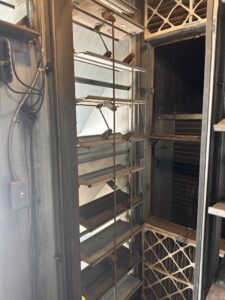
A broken fan, a failed actuator, a damper that won’t move: any of them cuts off the airflow or the tempering the coil was counting on. Outdoor-air dampers are the usual offender. They’re often set up for economizer mode, pulling 100% outdoor air during the swing seasons, which is great until winter. Then the springs rust, the actuator quits, or something as dumb as dust buildup binds the linkage, and the damper that was supposed to close just… doesn’t. It hangs open, freezing air pours across the coil, and that’s the ballgame.
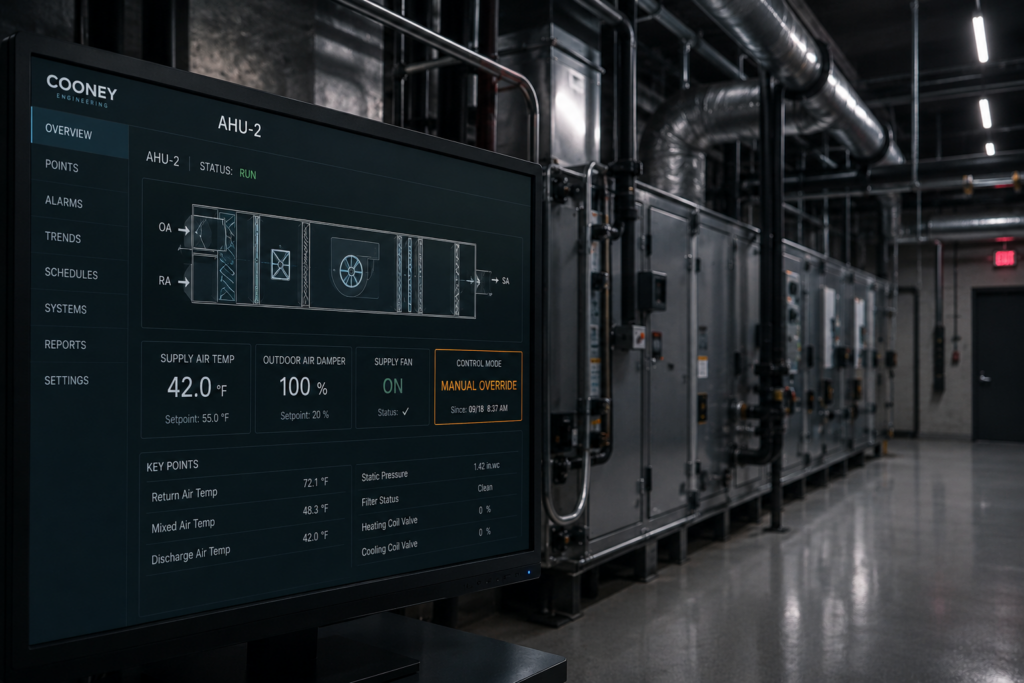
Human Error
This one’s the most human, and probably the most common. A tech bumps a setpoint to fix some nuisance in one season and never sets it back. Or he cracks an outdoor-air louver open for more fresh air on a mild day, totally reasonable in the moment. The problem shows up months later, when a cold snap comes through and pours far more outside air over a coil than it was ever sized for. Coil freezes, nobody saw it coming. A walk-through of your settings at the season change is about the cheapest insurance there is against this, and it’s the thing that’s easiest to skip.
Improperly Drained Coils
You’d think a drained coil is a safe coil. Not quite. It doesn’t take much. A few ounces of water left sitting in a low spot will freeze, expand, and build the same rupturing pressure a full coil would. Same physics, just from the water you thought you got out.
How to Prevent Frozen HVAC Coils
There’s no silver bullet here. Most facilities run a few of these at once, because every one of them has a weak spot. Here’s how they actually hold up.
| Method | How it protects | Dependency / weak point |
|---|---|---|
| Freeze Block® | Mechanically relieves pressure or temperature before the tube splits, then reseats. | Not meant as the only form of freeze protection — a fully mechanical safeguard for when real-world conditions aren’t perfect. |
| Freeze stats | Trip on a low-temperature limit and signal shutdown. | Nuisance trips lead to lowered setpoints; need annual calibration and trip-testing. |
| Draining in winter | Remove the water so there’s nothing left to freeze. | Timing is guesswork; labor-intensive; low spots can still retain water. |
| Recirculating pumps | Keep water moving so it stays above freezing. | Runs on power — lose it and flow stops; needs maintenance and pre-season checks. |
| Glycol | Lowers the fluid’s freezing point. | Cost, corrosion, energy penalty; concentration must be monitored and fades over time. |
Freeze Block® Coils
Freeze Block® is a drop-in coil that keeps the tube from bursting in the first place, rather than waiting to detect a problem. A combination relief valve picks up either a pressure spike or a temperature drop, lets out a measured bit of fluid so the ice has somewhere to go instead of splitting the tube, then reseats itself once things thaw. No flooding, no cap to swap, no scramble. The coil goes back to running on its own.
The reason that matters: it doesn't lean on controls, pumps, power, or a person catching it in time, which, if you read the section above, are the four things most likely to be failing at the exact moment you need them. It carries a 30-month freeze-protection warranty, 48 months with Smart Coil.
Freeze Stats
Freeze stats watch for a low-temperature limit and protect hot or chilled water coils in an air handler. They do help. The catch is the nuisance alarms. They trip when you don’t want them to, and what happens next is predictable: somebody gets tired of the calls and lowers the trip temperature, and now the stat won’t fire until it’s already too late. They only earn their keep if you calibrate and trip-test them every year before the cold sets in, and that’s the step that quietly slides.
Draining Coils in Winter
Pull the water and there’s nothing left to freeze. Simple in theory. The trouble is timing. With the temperature bouncing around and warm spells dragging into November, calling the right day to drain is mostly a guess. And it’s real labor at a time when most facilities departments are already stretched thin. Drain too early and you’ve given up the coil for weeks of weather you didn’t need to; drain too late and you’re cleaning up.
Recirculating Pumps
Keep the water moving and it stays above freezing even as it drops outside. Works well — as long as the pump’s been maintained and checked before the cold, which is its own ask. But notice the weak spot: it runs on power. Lose that, the flow stops, the water cools, and you’re right back where you started, except now you thought you were covered.
Glycol
Glycol drops the freezing point of the fluid, and it genuinely works, especially when the cold gets serious. It’s just not free, and the cost is the kind that keeps coming. The concentration has to be monitored and adjusted, and depending on the formulation it can turn corrosive over time. There’s a real energy penalty too: glycol is thicker and carries heat worse than water, so pumps work harder and heat transfer drops, and the whole system tends to get sized up to make up for it. The protection itself fades as the mix evaporates or gets contaminated. It’s a real tool. It just keeps asking for attention and budget.
Where glycol is used only for coil protection, many facilities evaluate using Freeze Block® to reduce glycol, which can improve heat transfer efficiency and cut pump energy. Run the numbers with our glycol energy calculator.
Frequently Asked Questions About Frozen HVAC Coils
At what temperature do HVAC coils freeze?
Water inside a coil freezes at 32°F (0°C) and below. As it freezes it expands, and the pressure can split a tube within minutes. Only part of the airstream needs to be at freezing temperature for this to happen; a single cold pocket can rupture one section of an otherwise normal coil.
How fast can a coil freeze and burst?
Often within minutes once the water in the tubes reaches freezing. That speed is why reactive methods that depend on controls, pumps, or staff response frequently can’t act in time.
Why do coils freeze in systems that were designed correctly?
Because real-world conditions break good designs. Power outages stop pumps and AHUs, dampers stick open, control or steam-trap failures cut off heat, setpoints get changed and forgotten, and coils get drained incompletely. The design can be sound and the coil still freezes.
Do chilled water coils freeze too, or just heating coils?
Both. Any coil with water in it (hot water, chilled water, glycol, or steam) can freeze if that water drops to 32°F and below. Chilled water coils are just as exposed during a winter freeze event as heating coils.
What’s the most reliable way to prevent frozen coils?
There’s no single answer, but the most resilient methods don’t depend on power, controls, or human response, the things that fail during a freeze. Freeze Block® coils prevent rupture by relieving pressure mechanically, which is why they hold up when the rest of the system doesn’t.
Does glycol completely prevent coil freezing?
Glycol lowers the fluid’s freezing point and is effective in extreme cold, but it adds cost and maintenance: concentration must be monitored, higher concentrations raise energy use, and effectiveness declines over time. It reduces freeze risk rather than removing the underlying failure modes.
Stop Guessing Whether Your Coils Will Make It Through Winter
If a coil froze once, it can freeze again. The failure modes behind most freeze events — power loss, stuck dampers, missed setpoints — aren’t things you can fully design out. Freeze Block® changes what happens when they hit.